

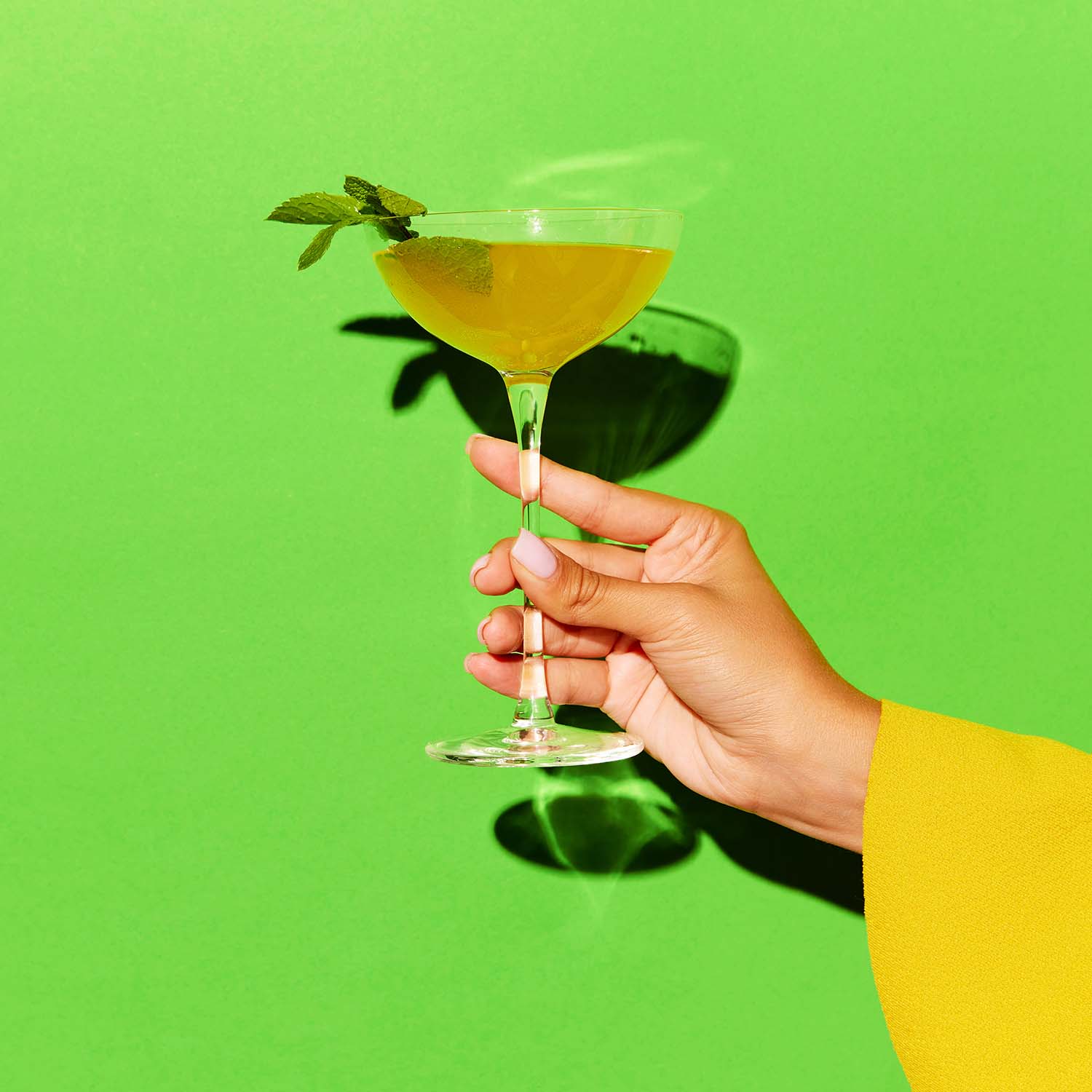




The Pisco Punch recipe
the classic from San Francisco
Add the sugar syrup and cloves to the shaker and muddle them for ten seconds with a muddler, so the cloves release their aroma.
Add the pisco, pineapple juice and lemon juice, then fill the shaker with ice.
Shake vigorously for 15 seconds, until the shaker feels ice-cold.
Double strain the cocktail into a large wine glass, so no pieces of clove or pineapple fibers make it through.
Carefully pour the dry white wine on top and stir briefly once.
What did you think of this recipe?
One click on a star is enough. If you’d like to add something, we’ll read it first before it appears here.
Save this recipe
Send the Pisco Punch recipe to your own email, so you’ll have it at hand when you’re ready to make it. You’ll also receive a €5 discount code for purchases from €50, for the glasses that go with it.
The story
In the nineteenth century, pisco was shipped from Peru to San Francisco, which had grown rapidly because of the gold rush. At the Bank Exchange, a saloon on the corner of Montgomery Street and Washington Street that opened in 1853, pisco was served in a punch. The last owner, Duncan Nicol, is considered the man who perfected the recipe and made the drink famous. He kept the preparation secret. According to tradition, it contained pineapple, citrus, sugar, and gum syrup, and he took the precise recipe to his grave. Writers such as Rudyard Kipling are said to have written enthusiastically about it. Prohibition brought the Bank Exchange to a close. The IBA version with white wine and cloves differs from what is known about Nicol’s recipe and is listed in the New Era category.
The right glass
The IBA specifies a large goblet: a stemmed glass with a spacious, rounded bowl. A large wine glass of around 50 cl does exactly that. The drink comes to approximately 17 cl, leaving plenty of room above the liquid, where the aromas of pineapple, cloves, and wine can gather. The stem keeps your hand away from the drink, as there is no ice in the glass. Take a look at our large wine glasses.

Royal Leerdam Adora Wine Glass 50 cl (6 pieces)

Bohemia Columba Wine Glass 50 cl (6 pieces)
Both sets together € 73,90.
The right tools
For a Pisco Punch, besides the glass you’ll need a Boston shaker, a muddler, a jigger for precise measuring, a cocktail strainer, a fine strainer for double straining, and a citrus press. These are the bar tools we use ourselves; you can find them all in our bar tools & cocktail sets.


Glass set (our choice 01) + 6 bar tools together € 180,65.
What do you make a Pisco Punch with?
For a Pisco Punch, you need wine. On every drink page, you can read the alcohol percentage, what it tastes like, which cocktails it pairs with, and which glass you need.


Variations & twists
To get closer to the old Bank Exchange, leave out the wine and clove and make pineapple syrup: pieces of fresh pineapple left overnight in sugar syrup. Gum syrup instead of regular syrup gives a fuller, softer texture. For a long drink, pour over ice in a highball glass and top up with sparkling water. Related drinks include Planter's Punch and Rum Punch with rum, and the Pisco Sour with egg white.
Serving tip
Press the pineapple juice from a fresh pineapple or choose a cold-pressed carton; juice from concentrate is too sweet and lacks freshness. Chill the white wine, because it is poured on top without ice. A pineapple wedge on the rim is not an IBA requirement, but it immediately shows what is in the glass.
Good to know
Which pisco do you use
Pisco is an unaged grape brandy from Peru and Chile. Peruvian pisco is distilled to drinking strength in a single distillation and may not be aged in wood or diluted with water; Chilean pisco may be and is often somewhat softer. For a Pisco Punch, Peruvian pisco works best because the grape comes through well alongside the pineapple and wine. An aromatic pisco made from the Italia or Torontel grape makes the drink floral. Quebranta is drier and earthier and gives the punch more body.
Why cloves and white wine
The clove gives the drink a warm, lightly spicy undertone that pairs well with pineapple. Muddling the cloves into the simple syrup releases their aroma into the sugar and distributes it evenly. Do not use more than three, because cloves quickly overpower everything. The white wine makes the drink drier and longer and adds fresh acidity. Choose a dry, crisp wine without oak, such as a Sauvignon Blanc or a Muscadet. An oaked Chardonnay makes the punch heavy and flat.
Making Pisco Punch for a group
As a punch, this was originally a drink to share. For ten people, briefly heat 15 cl of simple syrup with ten cloves and let it cool; this means you do not have to muddle them by the glass. Mix the syrup without the cloves with 60 cl pisco, 22.5 cl fresh pineapple juice, and 15 cl lemon juice, then chill. Just before serving, pour it into a punch bowl with a large ice block and add 30 cl of chilled white wine. A large ice block melts slowly, so the punch does not become watery. Find more ideas among cocktails for a group.
Difference between Pisco Punch and Pisco Sour
Both drinks revolve around pisco, but they come from different eras and countries. The Pisco Punch is a nineteenth-century drink from San Francisco: fruity from the pineapple, lightly spiced, and lengthened with white wine. The Pisco Sour originated in Lima in the twentieth century and is a short sour with citrus juice, simple syrup, egg white, and a few drops of bitters on the foam. The Sour is fresher and creamier; the Punch is rounder and easier to drink in larger portions. Those who enjoy one usually like the other too.
How much alcohol is in a Pisco Punch
Expect around 16 percent in the glass. The 6 cl of 40 percent pisco provides 2.4 cl of pure alcohol, and the 3 cl of 12 percent white wine adds another 0.4 cl. Together, that is 2.8 cl of pure alcohol, equivalent to more than two standard drinks. After shaking and adding the wine, you end up with around 17 cl. The pineapple and sugar mask the alcohol well, and that was what the punch was already known for in San Francisco. So drink it slowly.
Making a Pisco Punch without a shaker
A shaker is useful, but a jam jar with a tightly closing lid works too. Crush the cloves in the syrup with the back of a spoon, directly in the jar. Add pisco, pineapple juice, lemon juice and ice, screw the lid on tightly and shake vigorously for fifteen seconds. Pour everything through a fine strainer or tea strainer into the glass, leaving the cloves and fibers behind. Then pour the wine on top. Because pineapple juice foams when shaken, you still get a lovely, airy layer on top without a shaker.
Frequently asked questions
What goes into a Pisco Punch?
The IBA recipe contains 6 cl pisco, 2.25 cl fresh pineapple juice, 1.5 cl sugar syrup, 1.5 cl fresh lemon juice, 3 cl dry white wine and three cloves. Crush the cloves in the syrup, then shake everything except the wine and pour it on last.
What is pisco?
Pisco is a grape brandy from Peru and Chile. It is not, or barely, aged and is therefore clear in color, with a fruity, sometimes floral aroma. Pisco is usually around 40 percent alcohol. Peru and Chile both claim its origin.
Who invented the Pisco Punch?
The Pisco Punch is attributed to Duncan Nicol, the last owner of the Bank Exchange in San Francisco. Pisco was already being served there earlier, but Nicol made the punch famous. He kept his exact recipe secret.
Which glass do you use for a Pisco Punch?
The IBA specifies a large goblet, and a large wine glass of around 50 cl comes closest. The drink goes into the glass without ice, so the stem is useful. The spacious bowl captures the aromas of pineapple, cloves and wine.
Everything for your bar,
to one address
Glasses in hospitality quality, delivered as a set. Order today, delivered quickly.
Shop the glasses →